Blog
When the Power Goes Out, What Your Opener Actually Does
What happens to your opener when the power drops in Brandon, what a battery backup costs, and why 1991-era homes here are more exposed than newer builds.
What It Costs
A battery backup unit that lets your opener run through a power cut typically bolts onto the existing motor head or comes built into a replacement opener - we quote it per job once we know your model, so we won't put a number here that doesn't match your house. What we can tell you: across the service area, median household income sits at $71,012 and there are roughly 235,673 households, about 97,772 of them owner-occupied houses. That's a lot of driveways where the only way in or out during an outage is the garage door, which is exactly why backup power on the opener gets asked about more than almost anything else we install. If your opener is original to a house built anywhere near the 1991 median build year for this area, it almost certainly has no battery backup at all - that feature didn't become standard equipment until years later.
Checking It Yourself
Find the release cord - the red handle hanging from a track near the opener rail. Pull it and the trolley disconnects from the door, which means you can lift the door by hand even with the opener dead. Try it once when the power is on, not during the outage, so you know it moves freely and the springs are doing their job. If the door feels heavy or won't stay up on its own, that's a spring problem, not a power problem, and a battery backup won't fix it. Also check whether your opener has a battery compartment at all - look at the motor housing for a small door or a backup light. Openers installed in homes built across the 1980s and 90s stock common to this area often predate that feature entirely, so don't assume you have backup power just because the unit looks newer; some replacement openers get installed without it to save on the install cost.
The Problem
Garage doors here aren't failing because of frost or ice - this is a mild temperate climate band, so the freeze-thaw cycling that cracks seals and stiffens hardware in colder states isn't the driver. The failure pattern we actually see is age catching up with houses built between 1979 and 2013, median year 1991: openers that have run 20-plus years on original circuit boards, with no battery backup, no surge protection, and gear sets worn from use rather than weather. A power cut just exposes what was already tired. The door doesn't fail because the power went out - the opener fails because it was already near the end of its working life, and the outage is just the moment nobody can get the car out.
What Local Conditions Do
Without hard freezes to worry about, the main climate-driven stress on openers and doors in a mild temperate band like this is heat and humidity working on electronics and lubrication over time, not sudden cold snaps that seize mechanisms overnight. That means failures tend to be gradual - a board that gets flaky in summer heat, a chain that stretches, a sensor eye that drifts out of alignment - rather than the single hard-freeze event that takes out an opener all at once elsewhere. Combined with housing stock that runs mostly 1980s to 1990s across the 27 named communities in this part of the service area, the openers reaching the end of their life now are doing so because of accumulated years and duty cycles, not storm damage. Honest limitation: we don't track or have data on outage frequency or grid reliability for this area, so we can't tell you how often you'll actually lose power - only what your opener will and won't do when it happens.
Questions
Common questions
Will a battery backup run my garage door opener during a long power cut?
It depends on the model, but most backup batteries are built for a handful of cycles over a few hours, not days. They're meant to get the door open or closed a few times while you wait, not to run the opener indefinitely. We'll tell you the runtime for the specific unit we'd install once we see your opener.
My house was built in the early 90s - does my opener have battery backup?
Almost certainly not. Battery backup wasn't standard equipment on openers from that era, and the 1991 median build year for this area means a lot of original or first-replacement openers out there predate the feature. You'd need to check the unit directly or have it swapped for one that includes it.
Is it safe to manually open the door during a power cut?
Yes, if the springs are in good shape. Pull the red release cord to disconnect the trolley, then lift by hand. If the door feels heavy, drops fast, or won't hold position partway up, stop - that's a spring issue, and we don't recommend forcing a door with weak springs.
Do I need a battery backup if I don't lose power often?
We don't have data on how often this area loses power, so we can't tell you how likely you are to need it. What we can say is that it's a one-time install cost against the inconvenience of being locked in or out with a dead opener, and that's a call only you can make for your situation.
Recommendation
You Might Also Like
More garage door guides for Brandon homeowners.
What Brandon Homeowners Actually Deal With on Garage Doors
Garage door costs and checks for Brandon homes built 1979-2013, where original hardware and mild-climate doors often need attention after two or three decades.
Read guide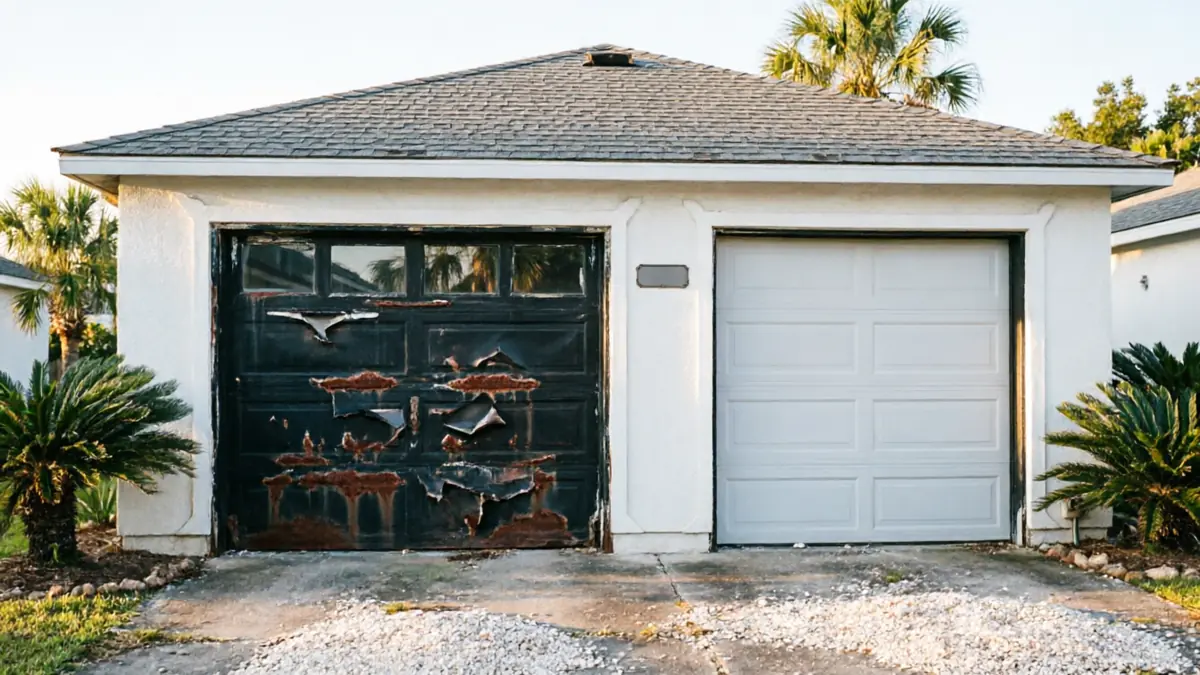
Weather Seals and Draughts: What Brandon Homeowners Actually Deal With
Brandon homes built mostly from 1979 to 2013 run original or aged bottom seals.
Read guide
Is Your Old Brandon Garage Door Still Worth Fixing?
Most Brandon houses date from the late 1970s to the 2010s.
Read guideReady when you are
Need a garage door sorted in Brandon?
Brandon Garage Door Pros repairs and installs garage doors, springs and openers in Brandon, FL and the surrounding area.